28 December 2008

Seven Laid-Off New Yorkers Share Their Stories

Since August, 33,000 New Yorkers have lost their jobs.

I’m a workaholic, so it’s a little hard to step back and enjoy this free time. I’m going back to things that I enjoyed when I was younger. I’ve been cooking up a storm. I’ve been really diligent with Pilates and have taken up knitting again. I’m almost done with a little blanket for my cat.

You have to maintain a positive attitude. It does pass, but it takes time. Many people who were laid off from the big banks may never go back to the financial industry; they just don’t realize that yet. You have to ask yourself, “What is the talent that I offer, and where can I put that to use?” I’m reinventing myself. I want to go into the not-for-profit sector and do something more meaningful with my life. In my mind, as of that day, I retired from the investment services. It just wasn’t satisfying as far as giving back to people, and the current system is not the industry I remember. I’m looking for more now.

read more digg story

26 December 2008

SharePod

One of the things I hate about iPods is that I can't take music on my iPod and re-upload it to my computer if I ever lose the music on my computer. SharePod is freeware that allows me to do exactly that.

SharePod

19 December 2008

Mancrush

I have a mancrush on Rachel Maddow. I don't know why. I hate political talk shows because they get on my nerves. I like her show though. Maybe it's because she's smart, funny and a real person.

He said WHAT?

This guy is such a tool. I can't believe he quoted Kipling and left out the next line. I wish he'd resign already so we can move on with our lives.


15 December 2008

At least he's consistent...

I love this guy. Even when the market is tanking and the world economy is in crisis, he remembers to hold his grudges. I have to admire that quality about him -- at least he's consistent.

In the bleakest stock market of the past 70 years, when hedge funds and 401Ks alike have cratered, few people are smiling. But short seller Jim Chanos, whose fund is up 50%, is having the time of his life.

On the morning of November 4, Jim Chanos, president of Kynikos Associates on West 55th Street, the world’s biggest short-selling hedge fund, read an article...with irrepressible glee. A colleague had e-mailed him a link. The headline: GOLDMAN FUND LOSES $990M AFTER 10 MONTHS.

His East Hampton neighbor, Marc Spilker, managing director of the Goldman Sachs division responsible for the billion-dollar loss, was finally receiving his comeuppance. In June 2007, Spilker decided to widen the rather narrow footpath from his house on Further Lane to the beach. One afternoon, Spilker dispatched a crew to widen the path by bulldozing the hedges between his mansion and Chanos’s. Chanos was outraged. “I hope this is not a harbinger of how other Goldman senior executives may act when the markets become ‘just not lucrative enough for us!’ ” he wrote to friends at the time in an e-mail that just happened to find its way to the New York Post. Several months after the Post leak, Chanos pulled nearly $3 billion out of his Goldman trading account, costing the bank some $50 million in annual fees, according to a source, and brought a suit against Spilker. (Goldman disputes these numbers.) Now, a year later, as Chanos sat at his Bloomberg terminal reading the Financial Times’ account of Spilker’s recent hedge-fund woes, a smile broadened across his face. He sent out another mass e-mail to his friends, staff, and financial journalists, directing them to the news. “Mark [sic] Spilker (Head of GS Internal Hedge Funds, and Horticultural Hater) strikes again!”

read more

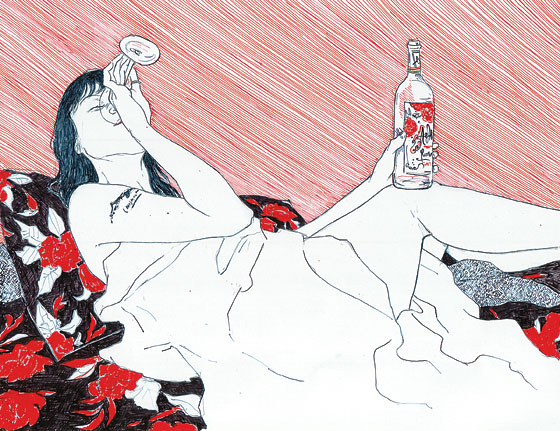
Women and alcohol

More women are drinking, and the women who drink are drinking more, in some cases matching their male peers. This is the kind of inequality nobody was fighting for. Alex Morris explores this in Gender Bender.

“You just adjust what you’re saying,” ... “Sometimes I’m like, I’m an alcoholic. Sometimes I’m like, I just drink a lot. Workaholic. Alcoholic. Workaholic. Alcoholic. How do you know if you have a problem?” She takes a sip and shrugs.

I don't have anything against women that drink. I fall into the demographic of women that drink and drink often. I barely drank in high school or college. I started drinking in my mid 20s and my tolerance has grown since then.

I started drinking as a way to socialize both in and out of the workplace after college. When I began to work long hours in a high pressure male-dominated environment, I started to drink more.

I drank in part because I was overworked and overstressed. When I'm short on personal time, I tend to party harder to compensate for my lack of free time. I loved the rush of working under intense pressure, drinking and partying until I was so tired my eyes couldn't stay open, forcing myself to get up after 3 hours of sleep, still hung over, only to repeat the process. Being that busy and exhausted allowed me to avoid thinking about how I didn't have a life besides work. I didn't have to reflect on whether I was "happy." The rush of always being on the go, of always being under pressure, of always being extremely busy, of always having yet another crisis to solve was addictive. I loved the sudden clearheadedness and certainty I had for every decision I made. It helped me feel like I (and my job) made a difference in the world.

Then again, I'm always at my best in emergencies and under extreme pressure. The more I'm overscheduled and stressed, the more I want to take on more both professionally and personally. If I worked 14 hour days, I'd start training for a marathon. If I worked 12 hour days and was training for a marathon, I'd start volunteering at a local elementary school once a week. If I worked 12 hour days, was training for a marathon, was already volunteering at an elementary school, I'd start swimming every other day just to see how far I could push my body. See the pattern? People (me) with personalities to tolerate extremes are attracted to jobs that demand those extremes. Short of doing drugs, which I have neither the interest or aptitude for, drinking heavily was the fastest and most socially acceptable way to burn the candle at both ends.

Then, there was the matter of gender and environment. In a male dominated environment, drinking was sometimes the only thing I had in common with my male counterparts. I had no interest in sport spreads, gambling or golf, and my co-workers could care less about windsurfing, sustainable agricultural practices or the latest Barbara Bui collection. So, we drank because that was the one way we could all show how big our BSDs were. Sometimes, I won. Sometimes, they won.

While the reasons I started drinking are similar to some of the reasons women drink in Morris' article, I wouldn't have kept drinking if I didn't like it. Fortunately for my liver, I no longer drink for any other reason than because I want to, and I try not to drink to excess. As Morris points out, there's nothing wrong with women that drink. It's just notable and somewhat unfortunate that women feel they need to drink in order to fit in with their male counterparts.

However, even without the pressure of fitting in with male counterparts, women have started drinking as much if not even more than males. Statistics have shown an increase of women that binge drink, which is unhealthy. But, while it's true that binge drinking isn't good for you, the general American definition of binge drinking for women is 4 or more alcoholic drinks in a row. Four (or more) drinks in a row seems like a normal night out with the girls, so perhaps I'm proving Morris' point. Which probably also explains why I don't think increased number of women drinkers is a big deal, although I do find Morris' article interesting.

Excerpts I found interesting:

That more women are drinking, yes—more than 48 percent acknowledge having had at least one drink in the past month (up from 42 percent in 1992). But beyond that, the women who drink are drinking more. The number of women who identify as moderate-to-heavy drinkers has risen in the last ten years, while the number of women who say they are light drinkers has declined. At the same time, men are reining in their drinking, meaning that the gender gap of alcohol consumption is narrowing all the time.

“As women ‘immigrated’ into the culture that was once unique to men...they picked up a lot of the same mores and attitudes and behaviors and ideas about what is socially acceptable that men had previously held. We call this acculturation—people adopt the drinking attitude and behaviors of the dominant culture.” Which explains why researchers have found that women in the demographic closest to being dominant (young, white, middle-class, educated) are leading the charge in terms of increased alcohol consumption.

The transition from high school to college marks the greatest increase in substance abuse among women, and the more educated a woman is, the more likely she will be to drink throughout her life. “College campuses are the place where drinking norms are set for educated individuals,” says Jon Morgenstern, a professor of psychiatry and vice-president at the National Center on Addiction and Substance Abuse. “The rate of drinking is astronomical. College is really a training ground for becoming an alcoholic.” And these days, the gender gap on campus is reversed: Fifty-five percent of college students who meet the clinical criteria for alcohol abuse are female.

The rate of frequent binge drinking increased by 124 percent between 1993 and 2001 at all-female colleges. When Amstel Light began marketing directly to women, its sales volume reportedly went up by 13 percent. Suddenly, alcohol commercials weren’t just of the big-breasted, mud-wrestling lineage. A Dewar’s ad from the era showed a lovely young woman donning her work clothes while a bare-chested man slept in the bed beside her. Tagline: “You finally have a real job, a real place, and a real boyfriend. How about a real drink?”

...Alcohol ads appeared during thirteen to fifteen of the most popular shows among teenagers and increasingly in women’s magazines, where according to Jernigan, in 2002 girls 12 to 20 saw 95 percent more ads for alcopops than women 21 and above. New alcopop flavors proliferated, Jell-O shooters showed up in grocery-store aisles, and companies rolled out vodkas in increasingly exotic flavors. “How many guys are going to drink a strawberry vodka?...There’s a clear effort by the industry to create products for female drinkers. And it has had an effect.”

Drinking has become entwined with progressive feminism. “I don’t think that the drinking in and of itself is feminist, but I do think that it comes from a feminist place, that it can bolster one’s sense of herself as liberated... You know, the whole point of Third Wave feminism is that individual choice should not be judged. If you choose to opt out and be a stay-at-home mom, then that’s your choice.” And if you choose to drink yourself unconscious in some random guy’s bed, that’s also your prerogative. To say that you shouldn’t would be paternalistic hand-wringing, implying that a woman needs to be protected from herself.

But the paradox of a woman exerting her power by making herself, to one degree or another, incapacitated does not read as a disjunction to most of the women I spoke with. On the contrary, a woman’s control over her life—and the decision of when and how to lose that control—seems to be the point.

He said WHAT?

I've lived in a rent-stabilized walk-up apartment in downtown Manhattan for the past four years. I've noticed that rents in nicer units near me have fallen. Since my rent is rent-stabilized, I expect it to be slightly below market.

Plus, my building is pretty neglected even by New York City walk-up standards. My neighbor's dog urinates daily in the hallway, and no one cleans it so the building reeks of urine. We have a rodent problem. There is a hole in the corner of my bedroom floor so I can look down into the unit below mine and hear everything that goes on there (and vice versa). Our bathtub leaks. Our front door lock is broken, so I installed a deadbolt which is the only lock we use on our door.

In addition to our problems with the general care of the building, the building has been subject to several acts of crime. In 2008 alone, our neighbor was mugged at knifepoint by a man waiting in the stairwell. The apartment on the floor above ours was burgled via fire escape.

The management company and super have been generally unresponsive to our requests to have the dog urine cleaned, the hole repaired and the lock in the front door replaced, but we have not complained too much and are low maintenance tenants. When I began to take stock of the cost of living right after I lost my job, I called my management company to ask if they would consider lowering my rent by $200 so it was back in line with my rent in 2007.

I'd noticed tenants in my building had been moving out (probably for the reasons listed above), and the unit across the way from my apartment had been empty for at least 3 months so the management company was losing money on a monthly basis. The way I saw it, it would be expensive for me to move out, but in the long run, I'd make up the loss of my deposit through the lower rent and nicer amenities. It'd be costly for my management company if I moved too. Yes, I'd forgo my deposit of two months rent, but in the long run, the management company is required to spend a minimum of $5,000 to fix up the apartment before they can take on a new tenant, and the unti wouldn't be able to command the same rent I was paying (even at 2007 levels) for the next tenant. A decrease of $200 would this bring my rent back in line with the market and would also help me considerably with my short term finances until I found a job.

When I explained this to my management company, I got the run around. After several tries, I spoke to Paul S. His response was, "I don't understand what an extra $200.00 would do for you if you no longer have a job. It sounds to me like you just made up being laid off as an excuse to renegotiate your rent."

I didn't think it was any of his business, but I explained I had a little severance. Paul then said the decision wasn't his to make, and I needed to speak to Mark W.

I called Mark W. every day for the next two weeks. He was always "out of the office." I left him a message each time I called. He never called me back.

Eventually, I received another call for Paul S. Mark W. had asked him to call me. I restated my request, and Paul S said "he would ask." He stepped away from the phone for 30 seconds and came back to tell me, "Mark says no."

I'm pretty certain Mark didn't say anything and that the management company just doesn't want to entertain my offer. It was pretty unprofessional for them to give me the run around -- if they didn't want to negotiate, they should have told me no upfront.

14 December 2008

He said WHAT?

"I want to put this in that."

That's what he said to me at the end of our date the other night.

A date that began with a dinner where I tried to order a salad as a starter.

He wanted us to share a starter and an entree, which I was happy to do.

I wanted the salad.

He "suggested" several times that I order the hummus or the chicken lettuce wraps instead because it was more value for the money (a salad was "just lettuce and croutons").

Unwilling to have to negotiate for my dinner, I decided if he didn't want me to order the salad, I'd just share the entree with him and forgo the starter. We ended up sharing a salad and entree for our dinner.

By the time the movie ended, it was late. He walked me home and wanted to come upstairs. I was tired and had an early day ahead of me, but he had tried SO hard to be sweet that night. After having known him for only three months, I knew it was difficult for him to part with money spent on someone other than himself. I let him up but warned him it was only for a few minutes because I really needed to go to sleep soon.

We sat on my couch, channel surfed the telly, talked and cuddled a bit. It was all very PG-13.

Despite his many personality traits that are incompatible with mine, he's smart and has interesting ideas. The conversation was good. His attempts to get me to lay down on the couch with him were not so great though.

He interrupted me mid-sentence and said, "I want to put this" (grabs his crotch) "in that" (pokes my crotch with his forefinger).

I kid you not. It really happened. The date was officially over.

13 December 2008

Happy Bday, W!

Happy bday, girlie! W's bday two weeks after the fact, but we're celebrating nonetheless!

12 December 2008

I was born a pain in the ass

Parents are so funny.

Since I was rightsized at the beginning of last month, my Dad has called me every Friday night to "chat." He inevitably asks me if I've found a job yet. Of course I haven't found a job yet, as the economy is on the verge of a financial meltdown. Every firm is job cutting, not job creating! His question adds to my general sense of discomfort and anxiety over the uncertainty of my future income stream. I mean, how will I pay for rent or feed myself???


When I spoke to my Dad last Friday, I promised him that he'd be the first person I'd call once I found a job, but only if he would stop asking me about it every time we spoke.

I think he understood because when he called tonight, he made no mention of my job search or employment status. Instead, he asked, "Any news?"

I chuckled at his question. To give him credit, he "technically" didn't ask me about employment. He's purposefully literal. Wily.

I must be my father's daughter, because I can be stubbornly obstinate. I "misunderstood" his question and filled him in on the mundane details of my life. We both knew what he was dying to ask.

I appreciate Dad's restraint, even if he couldn't quite seem to let go of his concern about my ability to support myself. I guess parents can't help but be parents even when their children are full grown.

As for grown children? Well, I guess I can't help but be the same ornery pain in the ass kid I once was either.

It looks like Dad and I will probably keep having our weekly "chats" where both of us will continue to ignore the proverbial employment elephant that's the third caller on the IP phone with us. At least until I find a job, that is.

04 December 2008

Man tries to pay bill with spider drawing

Trust Aussies to have a wicked sense of humor. If I don't find a job soon, I may have to attempt to pay my bills this way too!

read more

(The letter reminds me of Letters from a Nut.)

03 December 2008

01 December 2008

This is what I've been doing

now that I am unemployed and have free time.

30 November 2008

Uh oh, gold diggers may soon have to find real jobs!


With the market in serious trouble, well-to-do bankers and hedge fund guys in search of arm candy is harder to come by.

...being unemployed is not hot. Real estate broker Sammy, a 37-year-old "single girl in the dating scene" (who would rather keep her real name private so that her boss doesn't know she's a gold digger), wrinkles her nose in disgust. "Will I knowingly date somebody who is in the sh--ter right now? Probably not." Sophie agrees, "I would never go out with someone who came up to me and said, 'I don't have a job.' " Emilaya shakes her head. "No, no, no." Even the non-English speaker shakes her head no. It's universal: No banking job, no service.

Engineers Explain Women

25 November 2008

Thank goodness for good friends!

In "Is Urban Loneliness a Myth?" Jennifer Senior explores living alone in the the Big Apple:

Manhattan is the capital of people living by themselves. But are New Yorkers lonelier? Far from it, say a new breed of loneliness researchers, who argue that urban alienation is largely a myth.


There are good public-health reasons to be concerned about loneliness. In the last couple of decades, researchers have started measuring the effects of social isolation, and they aren’t pretty. There’s been an avalanche of studies, for instance, showing that married people are happier and healthier, while the odds of dying increase significantly among the recently widowed, something known as the “widowhood effect.” There’s evidence suggesting that strong social networks help slow the progression of Alzheimer’s. There’s even better evidence suggesting that weak social networks pose as great a risk to heart-attack patients as obesity and hypertension. There’s also evidence to suggest that the religious people who live the longest are the ones who attend services most frequently rather than feel their beliefs most deeply. (It’s not faith that keeps them alive, in other words, but people.)


Studies show that loneliness is associated with morning surges in cortisol, the stress hormone, and increased vascular resistance, which results in higher blood pressure. They also show the lonely drink more, exercise less, get divorced more often, and have more family estrangements and run-ins with the neighbors. And they’re fatter. In one of my favorite experiments described in Loneliness, students were divided into two groups and told to evaluate … bite-size cookies. Specifically, researchers took aside each of the kids in one group and told them that no one wanted to work with them, so they’d have to work on their own. The others, by contrast, were each privately told that everyone wanted to work with them, but they’d still have to work on their own because it would be impossible to work with so many people. Then all of the participants were handed a plate of cookies and told to evaluate them. On average, the ones who had been told they were universally liked ate 4.5. Those who had been told they’d been universally rejected ate 9. “Is it any wonder we turn to ice cream,” the authors ask, “when we’re sitting at home feeling all alone in the world?”


Given how many New Yorkers live alone—in Manhattan, 25.6 percent of households are married, whereas the national average is 49.7—one would think we’d be at an increased risk for practically all these conditions. But Cacioppo points out that loneliness isn’t about objective matters, like whether we live alone. It’s about subjective matters, like whether we feel alone. To determine how satisfied people feel with their relationships, research psychologists generally rely on a twenty-question survey called the UCLA Loneliness Scale, which breaks down our connections into three groups: intimate (whether we have a partner), relational (friends), and collective (church, colleagues, baseball teams, etc.).


The results of these surveys have crucial—and positive—consequences for urban environments. Loneliness, it turns out, is relative. Widows are likely to feel better in a community with more widows (Boca Raton, Florida, say) than a community with only a few single elderly women. And singles are likely to feel better in a town with more singles … like New York. It’s true that marriage is still the best demographic predictor of loneliness. But Cacioppo stresses it’s a very loose predictor. People can have satisfying connections in other ways, after all, and people in bad marriages might as well be on their own: Cacioppo’s latest study, based on a sample of 225 people in the Chicago area, shows that those in unhappy marriages are no less lonely than single people, and might even be more so. Nor do rotten marriages do much for your health. A couple of years ago, Cacioppo teamed up with Linda Waite, co-author of The Case for Marriage: Why Married People Are Happier, Healthier, and Better Off Financially, whose conclusions about the health-positive effects of the institution drove feminists and fatalists like myself into a tizzy. They recruited a new pool of sample subjects and more or less asked the same questions Waite originally did, but also inserted questions to see if their participants were lonely. And what did they discover? That married people were indeed healthier—if they weren’t lonely in their marriages. If they were, the health benefits were so negligible the researchers considered them statistically insignificant.

“In our data,” adds Lisa Berkman, the Harvard epidemiologist who discovered the importance of social networks to heart patients, “friends substitute perfectly well for family.” This finding is important. It may be true that marriage prolongs life. But so, in Berkman’s view, does friendship—and considering how important friendship is to New Yorkers (home of Friends, after all), where so many of us live on our own, this finding is blissfully reassuring. In fact, Berkman has consistently found that living alone poses no health risk, whether she’s looking at 20,000 gas and electricity workers in France or a random sample of almost 7,000 men and women in Alameda, California, so long as her subjects have intimate ties of some kind as well as a variety of weaker ones. Those who are married but don’t have any civic ties or close friends or relatives, for instance, face greater health risks than those who live alone but have lots of friends and regularly volunteer at the local soup kitchen. “Any one connection doesn’t really protect you,” she says. “You need relationships that provide love and intimacy and you need relationships that help you feel like you’re participating in society in some way.”


read more digg story

06 November 2008

Escape from NYC

If I don't find a job soon, I may have to try and find an affordable way to escape to some place sunnier. NYC is depressing in the winter when I don't have an income!

NY Mag offers suggestions for sunny escapes for all budgets, but for someone with a negative income flow, it'll still be a stretch.
read more digg story

05 November 2008

Surprise, you've been rightsized!

Yeah, that's right.

Rightsized.

And, by rightsized, what they actually meant was, downsized.

As in: You have been laid off. Now, get out.

Not surprisingly, just because they called it rightsized didn't make me feel any better about being downsized. It might have made me feel worse. Except that it's not sunk in yet. Because, I'm not upset yet.

As of 10am this morning, I made the walk of shame from my office building down the street to the building that houses my former company's HR department.

I was joined by 3,199 other rightsized employees that made up the 10% reduction of the 32,000 large workforce that the company promise earlier last month. Each of us carried bankers boxes, duffels and shopping bags full of personal items quickly gathered from our desks in the few minutes we had between the time we were told we'd been laid off and the time it took to return to our desks to turn off our computers and leave the building.

We didn't have to speak to each other, we didn't have to make eye contact, and no one had to ask where the other was headed. We were all able to tell who was on the walk of shame with us. We were all able to tell who expected the axe to fall, they were the ones who walked with a spring in the step, relieved that the uncertainty was finally over. We were all able to tell who had hoped they'd be the ones to be asked to leave, they were the ones with expressions of hope, who saw this as an opportunity to pursue their dreams. The saddest to see, however, were those it took by surprise, evidenced by the subtle stoop of defeat in the shoulders, the shopping bags crammed full of banking tombstones, the crystal paperweight presented to employees that have been with the firm for at least 10 years, awards presented by financial associations and preschool drawings with bold headings that read "To: Dad."

Us 3,200. Strangers to each other, and strangely united. We didn't speak to each other. No one was in a talking mood. We didn't make eye contact. Guess no one was in a looking mood. Stone faced, everyone gazed resolutely ahead as we headed to HR.

HR was all business. We walked in, turned in our employee IDs, blackberries, laptops and corporate cards. In exchange, we got our severance packages.

Package is a generous word.

As I left HR, I ran into some former colleagues walking in. We exchanged hugs and made tentative plans for lunch along with lame half jokes about how we'll now have time to have lunch.

Now that we're unemployed, we'll have time to do the things we've always secretly envied others for having the time to do. Our secret envy was also our secret source of superiority and self worth. Our lives were so busy, our jobs so important to us, we never had time for anything other than work.

"So, now we have tons of time, want to do lunch next week?"

"Sure," I say, "let's do lunch."

Welcome to rightsizing.

03 November 2008

A cat obstacle course?!?

WTF! I am strangely fascinated and weirded out at the same time.
An official blueprint for the obstacle course set up last week at Madison Square Garden during the CFA-Iams Cat Championship’s Feline Agility Competition. Revi (pictured), a five-month-old Maine Coon kitten from Richmond, Texas, finished in eight seconds, beating out 29 feline rivals to win the race (which is separate from the best-in-show contest). Her prize: 60 pounds of cat food.

read more

10 October 2008

The Village Petstore and Charcoal Grill

Banksy's NYC installation:


New Yorkers have welcomed the reclusive graffiti artist Banksy with caution.In his first official exhibition in the city, the Briton has set up a fake pet supply shop, complete with large furry animals, rhesus monkeys and rabbits, in Manhattan.

But the would-be creatures are all fakes created by the artist who aimed to question "our relationship with animals and the ethics and sustainability of factory farming" in his work at The Village Pet Store and Charcoal Grill.

His exhibition, which contains no paintings or graffiti, features a robot monkey wearing headphones and watching television in a cage, a fake-rabbit wearing a pearl necklace, and chicken nuggets with legs, busily dipping themselves in sauce.


read more digg story

The Village Petstore and Charcoal Grill

08 October 2008

10 things to love about the credit crunch

LONDON (MarketWatch) -- While the global credit crunch is clearly beginning to bite hard, there are some positives to the financial turmoil that it has wrought.

The U.S. election is no longer leading the news.

Whatever your brother-in-law's brilliant financial move was last year probably looks pretty boneheaded now.

Wall Street bigwigs are exposed as blubbering hypocrites in congressional hearings.

You probably didn't do anything as embarrassing as the head of Iceland's central bank, who issued a statement announcing a 4 billion euro loan from Russia when Moscow hadn't actually agreed to it.

The world will no longer have to spend trillions of dollars to cut carbon emissions since the crisis will do more to reduce greenhouse gases than all the government initiatives, wind farms and cap-and-trade schemes combined.

Capitol Hill bigwigs are exposed as blubbering hypocrites in congressional press conferences.

You probably didn't do anything as embarrassing as Germany's KfW Bankengrouppe, which transferred 300 million euros to Lehman Bros. just before the investment bank filed for bankruptcy.

Instead of foreign aid programs or the United Nations, your tax dollars will now go to fund assistance where it's really needed -- Wall Street.

Gasoline's back down to merely extortionate prices from obscenely extortionate prices.

It's as good a distraction as any from the Chicago Cubs' abject playoff failure.

- Tom Bemis, assistant managing editor

06 October 2008

Hippie, Yippie, Yuppie, Hipster! Schlemiel, Schlimazel, Hasenpfeffer Incorporated!

With New York City caught in the vortex of one of the worst financial crisis in history, is the New York of old to be the New York of new?

Jay McInerney looks back at 20 plus years...


I first remember hearing the Y-word in ’83, when I was living in the East Village... I was enjoying a hung-over midday breakfast (we didn’t use the word brunch in the East Village; it was breakfast whenever you woke up)... An ostentatiously besplattered painter was sitting next to me at the counter, and I heard him mutter, “Fucking yuppies.” I looked up to see a young couple I myself would have characterized as “preppy” waiting to be seated. They looked as if they were visiting from the Upper East Side—all chinos and oxford cloth. We were all uniformly nonconformist in our black jeans and our black Ramones and Television T-shirts. As a Williams alum, I knew all about preppies even before they’d gone mainstream with the publication of The Official Preppy Handbook in 1980. My younger brother, a Deerfield senior, was a preppy. Many of my classmates were preppies. But this yuppie thing was new to me.

The term probably first appeared in print in 1983, when columnist Bob Greene wrote a piece about former Yippie leader Jerry Rubin, who was hosting “networking” events at Studio 54. Greene quoted a participant as saying that Rubin had gone from being the leader of the Yippies to the leader of the yuppies. The neologism stood for Young Urban Professionals and might have gone down in history as yups if not for the Rubin connection. The term yuppies suggested a certain evolutionary—or devolutionary—trajectory from the hippie and the Yippie. The story had everything—the double irony of the revolutionary trickster turned entrepreneurial capitalist cheerleader and the setting in the glam palace of mindless hedonism, as well as a zippy catchphrase that actually seemed to describe an instantly recognizable new minority. Once we had a name for them, we suddenly realized that they were everywhere, like the pod people of Invasion of the Body Snatchers—especially here in New York, the urbanest place of all. We might have even recognized them as us.

From the beginning, there was a certain subject/object confusion associated with the yuppie concept, a certain “we have met the enemy and he is us” self-reflexivity to the phenomenon. Downtown mohawked squatters aside, it was sometimes hard to find a Manhattanite without some taint of the new lifestyle. Did gym membership qualify you as a yuppie? Snorting coke? Eating raw fish? When I heard a movie agent slinging the term at a group of bankers at the Odeon, I wondered about pots and kettles.

“Who are all those upwardly mobile folk with designer water, running shoes, pickled parquet floors, and $450,000 condos in semi-slum buildings?” asked Time magazine in its January 9, 1984, issue. “Yuppies,” we were informed, “are dedicated to the twin goals of making piles of money and achieving perfection through physical fitness and therapy.” The Yuppie Handbook, which had just been published, defined its subject: “(hot new name for Young Urban Professional): A person of either sex who meets the following criteria: (1) resides in or near one of the major cities; (2) claims to be between the ages of 25 and 45; (3) lives on aspirations of glory, prestige, recognition, fame, social status, power, money, or any and all combinations of the above; (4) anyone who brunches on the weekends or works out after work.”

Apparently, the creatures anatomized in The Yuppie Handbook were just common enough to elicit recognition, but not so general as to provoke a shrug. The concepts of “brunching” and “working out” were apparently new and humorous. A few of their defining characteristics—dhurrie rugs, potted ferns, pickled parquet floors—sound suitably dated. But many more—European automobiles, gourmet kitchens, computer literacy, designer clothing, and sushi—fail 25 years later to convey the exoticism that the authors seem to have intended. Oh, those wacky yuppies, eating raw fish and going to the gym.


read more

28 September 2008

Goodbye to one of the best summers ever!

I'm mourning the end of summer. Maybe it's because it's rained four days in a row. Maybe it's because it's dark and gray when I wake up, and dark and gray when I leave work these days. Maybe it's because when it's 8pm, it looks and feels like it's 11pm.

It doesn't really matter. What I'm trying to say is, I'm sad summer's over. This summer has one of the best summers I've ever had, and ... it's done. Sigh. In the next few weeks, I'll try to backfill entries so you know what I've been up to the past few months.

26 September 2008

Happy Birthday J!

J and D come to NYC to celebrate J's big bday!

J's Big Day!

20 September 2008

Who knew an 80s cover band could be so fun?

I caught San Francisco based 80s cover band Tainted Love at BB King's last night.

They were great. They played classic 80s and early 90s hits.

As with all 80s bands, I felt free to make a fool of myself. I sang along to the songs I knew, loudly and out of tune. I danced along badly, like a white guy. And, when I got too tired to dance, I compensated by pumping my fist in the air, like a white guy who can't dance, not even badly.

It was a band and a night that T would have loved.